

TL;DR
- Ripple projects $33 trillion in on-chain stablecoin volume for 2026, positioning itself at the center of institutional tokenization and XRPL adoption.
- The estimate was unveiled at the XRP Tokyo conference, highlighting Japan’s role as a regulatory testbed with 32 registered exchanges and $10 billion in trading volume.
- Ripple expects over $1 trillion in digital assets on corporate balance sheets and half of Fortune 500 companies to integrate digital assets in the near term.
Ripple displays a projection at XRP Tokyo 2026 that redefines the corporate message: $33 trillion in onchain stablecoin volume during 2026. The number functions as political assertion rather than financial prediction. Ripple declares that stablecoins are no longer optional. They are infrastructure. They are inevitable.
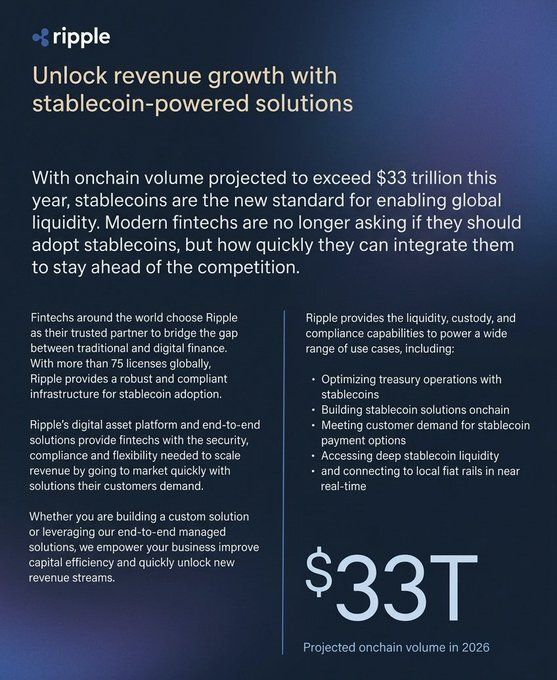
The company articulates its position directly. “With onchain volume set to exceed $33 trillion this year, stablecoins are the new standard for global liquidity. Modern fintechs no longer ask if they should adopt stablecoins. Instead, they ask how quickly they can integrate them to stay ahead.”
That sentence contains calculated strategy. Ripple does not sell stablecoins to fintechs. It sells inevitability. It sells the feeling that delaying is dangerous. That those who do not move now will fall behind. The language transforms optional competition into competitive necessity.
Context amplifies the assertion. $33 trillion would exceed the combined GDP of the United States and China. That comparison is not accidental rhetoric. It establishes that stablecoin volume would reach magnitude comparable to national economies. The implicit message: this is too large to ignore, too large to stop.
Ripple backs the projection with tangible credentials. The company holds more than 75 licenses globally. That is not an arbitrary number. Each license represents regulatory work, documented compliance, approval from authorities. Ripple converts heavy-load regulation into competitive barrier. Those who do not have 75 licenses simply cannot play in the same space.
Japan as Strategic Chessboard
Japan was not chosen by accident. The country introduced clear regulation early and continues leading in adoption. For Ripple, Japan is not a secondary market. It is proof of concept at institutional scale.
SBI Holdings, one of Japan’s largest financial groups, has partnered with Ripple since 2016. Together they formed SBI Ripple Asia to drive blockchain adoption across the region. That decade-long alliance is not standard commercial partnership. It is deep institutional integration. SBI accesses Japanese banks and financial institutions directly. Ripple accesses a distribution network that includes hundreds of institutions.
Japanese regulators adopted a progressive stance on digital assets. That regulatory clarity creates a favorable environment for RLUSD, Ripple’s stablecoin. However, Japan serves a deeper purpose: it functions as a laboratory where Ripple tests integration of blockchain solutions into traditional financial infrastructure at real scale.
Learning from Japan exports outward. Ripple exports adoption playbooks, compliance documentation, integration blueprints. What works with Japanese banks works with banks in Singapore, Hong Kong, Europe. Japan trains the system.
XRP Tokyo 2026 brings together Ripple executives, SBI Ripple Asia, and a16z Crypto. It is not a technical conference. It is a ceremony of power. It celebrates alliances that already function. It announces the ones coming. The $33 trillion projection does not appear without context. It appears surrounded by evidence that Ripple already controls critical infrastructure layers.
The conference emphasizes three areas: institutional adoption, real-world asset tokenization (RWA), and DeFi. That order is not accidental. Institutional adoption comes first because it generates reliable volume. RWA tokenization comes next because it requires institutions willing to tokenize. DeFi comes last because the other two generate liquidity that DeFi consumes.
Ripple transforms regulation, historically viewed as friction, into advantage. Those who have 75 licenses can operate where others cannot. Those integrated into SBI access depositors who trust SBI. Those understanding Japan’s playbooks understand how to institutionalize crypto globally.
The $33 trillion projection is not market prediction. It is Ripple’s definition of what “success” means. If they reach $33 trillion, that figure validates their architecture, their licenses, their alliances. If they do not reach that number, it will still be the largest anyone projected publicly, establishing the terrain where competitors must play.
Ripple executes institutional chess. Every announcement, every conference, every alliance moves pieces toward a position where Ripple’s stablecoins become infrastructure so assumed that ignoring it would seem irresponsible for any institution seeking to move quickly.
