


TL;DR
- Bitcoin’s technical channel pattern suggests potential decline toward sixty-nine thousand dollars.
- Halving cycle fractals indicate the twenty-twenty-five peak represents the cycle top.
- Historical “Sell in May” patterns during election years cause substantial Bitcoin selloffs.
The prediction of $250,000 for Bitcoin before year-end persists in the mouths of some of the sector’s most prominent investors, such as Tim Draper and Tom Lee from Fundstrat. However, this target would require the price to triple from current levels, something that technical patterns and historical cycles strongly discourage.
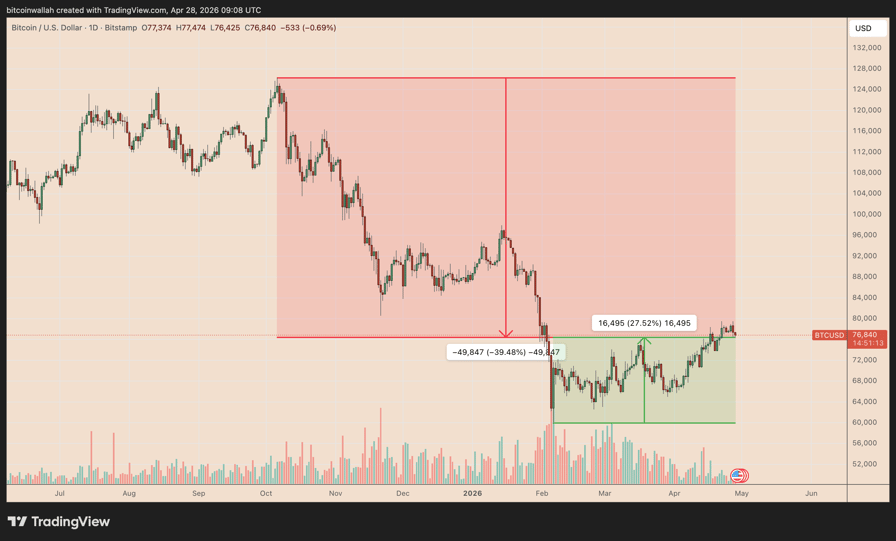
While the loudest bulls maintain their stance, emerging signals of technical weakness begin to dominate market analysis. Bitcoin descended from its October 2025 high of $126,000, and today trades around $77,000, representing a decline of 38% to 40% from that peak. The question that imposes itself is inevitable: are we facing a simple cyclical pullback or confirmation that the bull run already topped out?
Peter Brandt, a veteran futures market trader, identified a channel pattern on Bitcoin’s daily chart that could keep odds low for BTC reaching $250,000 in 2026. Technical analysis reveals that Bitcoin bounced at the upper boundary near $79,500 as resistance.
If the correction persists, the cryptocurrency risks declining toward the channel’s lower boundary, around $69,000, potentially during May. A break below that lower trend line could push Bitcoin toward $50,000 or lower territory if the setup unfolds as intended.
The Halving Cycle Tells a Different Story
Bitcoin’s price cycles have historically followed a clear pattern tied to its four-year halvings. Cycle peaks consistently occurred 12 to 18 months after each event. In 2012, the peak arrived within 12 months. The 2016 halving saw its top in 17 months, while the 2020 halving peaked after 18 months. The April 2024 halving fits squarely into this timeline. Bitcoin reached its all-time high of $126,000 in October 2025, roughly 17 to 18 months later—precisely where historical patterns suggested it would occur.
.png?prefix=media%2Fcontent)
Now, in late April 2026—over 24 months post-halving—BTC trades around $77,000, down 38% to 40% from that peak. This alignment strongly suggests the 2025 high may represent the cycle top, casting serious doubt on new highs for the remainder of 2026. The data speaks clearly: historical precedent indicates the bull phase has already concluded.
The “Sell in May” pattern adds another layer of caution to the narrative. During US midterm election years, Bitcoin has demonstrated a recurring tendency to decline sharply as spring turns to summer. In 2014, BTC dropped 61%. In 2018, the decline reached 65%. In 2022, Bitcoin fell 66%. Each of these declines began around May of those respective election years. Applying a similar framework to 2026, analysts project a potential decline exceeding 60%, which would place BTC near the $30,000 level.
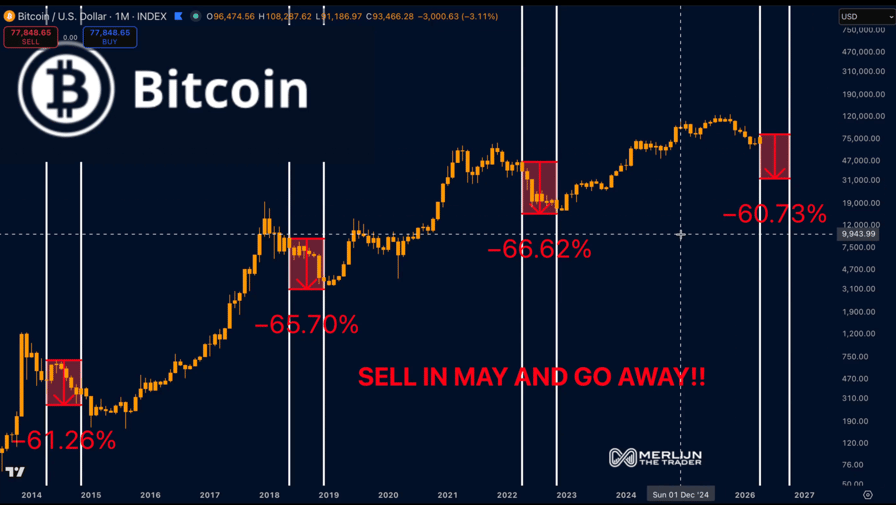
Midterm elections historically raise uncertainty over congressional control and policy direction. As campaign rhetoric intensifies in spring, investors cut risk exposure, slow buying activity, and brace for volatility. That backdrop significantly weakens the case for Bitcoin reaching $250,000 by year-end, even though several analysts—including those from Bernstein—see room for a more modest rebound toward the $100,000 to $150,000 range.
The gap between bullish predictions and technical reality widens each day. While some remain committed to the $250,000 narrative, the evidence increasingly suggests such optimism rests on hope rather than historical precedent or chart patterns. Bitcoin traders and investors must contend with a market that appears primed for disappointment rather than explosive upside.
