

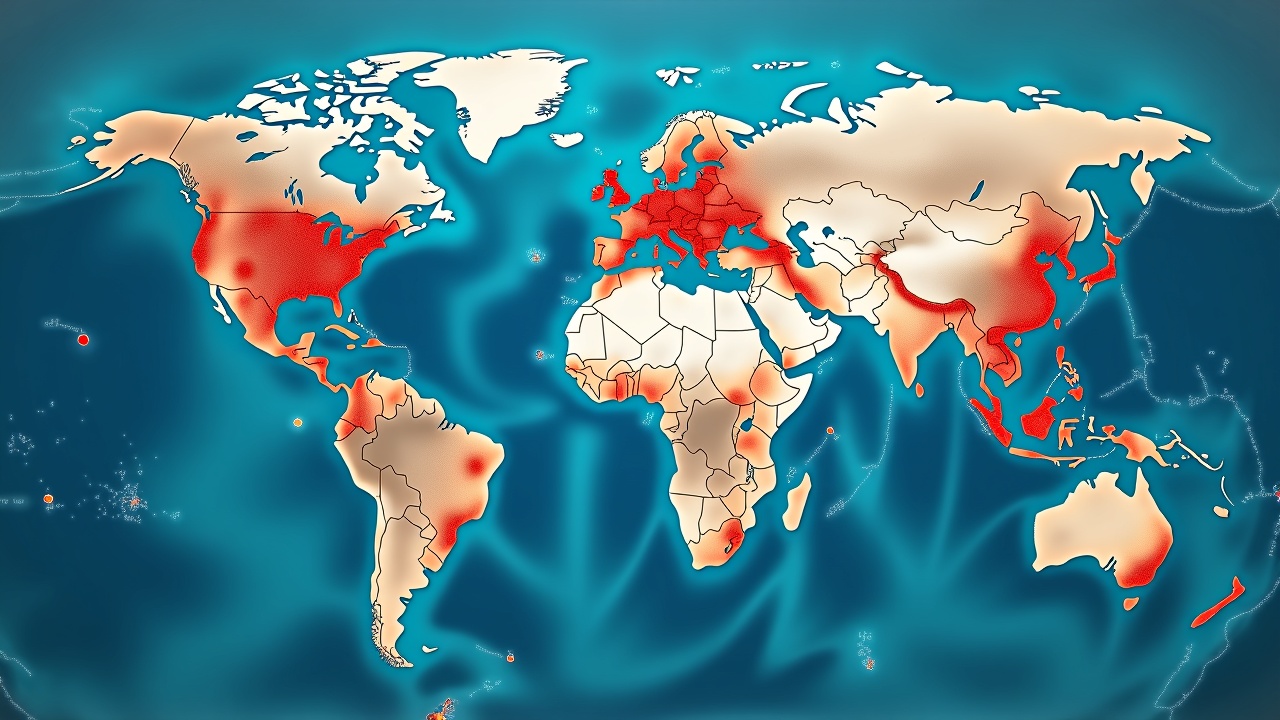
The hantavirus cluster aboard the MV Hondius cruise ship, anchored near Tenerife, injects a health-event variable into a macroeconomic landscape already contending with war, sticky inflation and an oil supply shock. As of May 8, the World Health Organization confirms eight cases, including three deaths—two confirmed and one probable.
The agency assesses that a large-scale epidemic on the scale of COVID-19 remains unlikely. Still, the hantavirus pulmonary syndrome mortality rate of nearly 38 percent among patients with respiratory symptoms keeps the worst-case scenario in view. Markets price tail risks, and the current backdrop leaves far less cushion for error than the 2020 playbook.
Spain began evacuating passengers from the vessel, and contact tracing proceeds under protocols refined during the previous pandemic. The physical containment appears effective for now. Financial markets, however, trade on forward uncertainty. The current macro mix differs sharply from the environment that absorbed COVID-19. The US-Iran war has already forced the International Monetary Fund to cut its 2026 global growth forecast to 3.1 percent in April. The Strait of Hormuz, a chokepoint for crude and fertilizer flows, remains under persistent disruption.
Brent crude oscillates near 100perbarrelafterspikingabove116 during the conflict’s peak. Food and fertilizer shortages ripple through import-dependent economies, layering a commodity cost crisis on top of military tensions.
Simultaneously, US headline inflation reached 3.3 percent in March 2026, more than a full percentage point above the 2.3 percent figure recorded in February 2020, before the WHO formally classified COVID-19 as a pandemic. Central banks now operate with narrower policy bandwidth. Rate cuts supply ammunition when demand collapses, but inflation above target complicates any swift easing.
The Federal Reserve faces a dual constraint: easing too fast reignites price pressures, while tightening further chokes an economy already stressed by war and energy costs.
Fragile Markets Remember The COVID-19 Liquidation Cascade
Risk assets have staged impressive rebounds from their February-March troughs. Bitcoin gained roughly 22 percent since February 28, and the S&P 500 closed at a fresh all-time high of 7,365 on Friday, recovering from its March sell-off. The US-Iran conflict paradoxically acted as a tailwind for certain risk assets, as investors bet on defense spending flows and a contained regional conflict. A potential health crisis disrupts that momentum by introducing demand-side uncertainty that no military budget can offset.
The memory of March 2020 remains embedded in trading algorithms and institutional reflex. The S&P 500 plunged 34 percent in just 35 days during the onset of COVID-19, falling from 3,386 to 2,237. Bitcoin suffered an even sharper liquidation, losing more than 50 percent of its value within two days after the WHO pandemic declaration.
Both assets recovered, but the recovery relied on unprecedented monetary stimulus that today’s inflation readings largely foreclose. The question for traders now centers on whether any escalation in hantavirus transmission would trigger a similar correlated risk-off cascade, this time with far less policy backstop.
The 2020 demand collapse sent US oil prices into negative territory for the first time in history. The current supply disruption around Hormuz creates a different sentiment. If a health scare weakens global economic activity, demand destruction could partially offset the supply shortage, though volatility would surge rather than abate. Two-way oil price swings of 10 percent or more within a quarter become plausible under a scenario where both supply and demand shocks hit simultaneously.
Precious metals, traditionally havens, face their own turbulence. Gold declined more than 12 percent since the US-Israeli strikes on Iran, and silver lost over 9 percent. During the 2020 shock, gold first sold off alongside equities in a liquidity panic, then rebounded to record highs as real rates collapsed.
Silver traced a similar path
The 2026 setup complicates any simple safe-haven trade because the dollar remains strong, and real yields do not yet signal a clear pivot. If a health event triggers a flight to cash, gold could again sell off in the initial phase before recovering, a sequence that punishes leveraged long positions.
The hantavirus cluster need not escalate into a pandemic to influence market psychology. Its transmission cycle—rodent-borne, with human-to-human spread still under investigation—differs substantially from a respiratory virus with airborne transmission.
The scientific fundamentals suggest containment probabilities remain high. However, a 38 percent mortality rate for symptomatic respiratory cases means that any expansion beyond the ship would immediately recalibrate health risk premiums across insurance, travel, and hospitality sectors. Equities trading at all-time highs incorporate virtually no pandemic insurance premium, making them vulnerable to even a modest outbreak extension.
