


TL;DR
- Public Bitcoin miners shift focus from BTC to AI for profits.
- Bitcoin mining revenue share expected to drop to 30% soon.
- Hashrate fell as miners prioritize AI over network security.
Public Bitcoin miners face an economic crossroads reshaping their business models. Over recent months, every major listed mining company announced plans to diversify into artificial intelligence, gradually shedding dependence on cryptocurrency as a primary income source. The shift reflects an uncomfortable reality: Bitcoin mining no longer generates sufficient returns compared to other applications of the same hardware.
Data reveals an abrupt transition. Bitcoin mining revenue once represented 90% of cash flows for large operators just years ago. Now, internal projections point to that share collapsing to 30% within two to three years. Companies already redirecting 80% to 100% of capacity toward AI report stock gains exceeding 500% over two years. By contrast, miners maintaining stronger Bitcoin commitment see their shares flat or in decline.
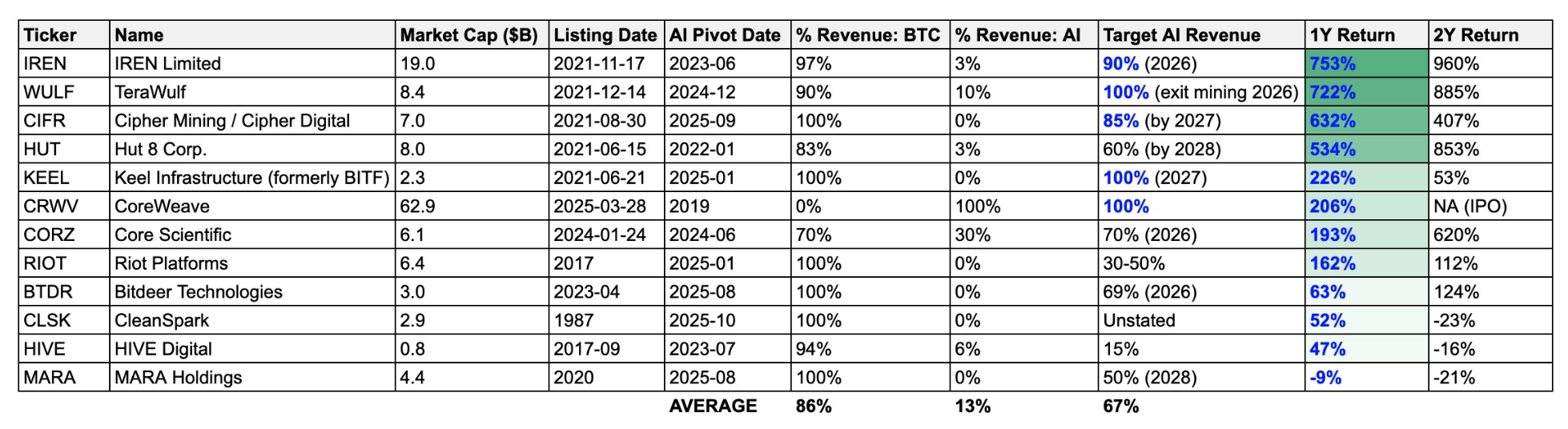
The operational strategy of these miners exposes something crucial: they are not replacing mining hardware. Current equipment will run until end of life. New investment flows toward AI processing centers, data transmission networks, and storage infrastructure. Bitcoin gets what remains: aging machines operated with minimal effort.
This shift creates tension within technical circles. Charles Edwards, analyst at Capriole Investments, warns that if figures prove accurate, the Bitcoin network faces existential risk. Committed energy for security drops. Dedicated hardware shrinks. Meanwhile, quantum computing threats advance while the protocol remains unmodified to resist them.
The Self-Regulating Market Defense
Adam Back, Blockstream CEO, offers a different perspective. He argues that when processing power (hashrate) declines, profit margins for remaining miners rise. The market then reaches equilibrium: miners who stay earn more per unit of work. They sell less Bitcoin to cover operating costs. Price climbs. The network self-corrects.
Back’s logic holds mathematical coherence. Yet it raises an uncomfortable question: is market equilibrium the same as network health?
Technical indicators already show movement. In March 2026, mining difficulty dropped 7.76%. Total processing power retreated from nearly 1 zettahash per second to roughly 870 exahash per second. Numbers that speak of a network losing muscle.
Cultural symbols matter too. MinerMag, the sector publication, changed its name to Energy Mag. Bitcoin 2026, the space’s flagship conference, renamed its Mining Stage to Energy Stage. Marathon Digital Holdings, the world’s largest miner, removed Bitcoin references from its website years ago. These shifts are not cosmetic. They express deep reorientation.
The question nobody clearly answers is whether a smaller network, with fewer miners, protected by higher margins but less total computational power, remains as secure as before. The problem is not that market equilibrium arrives. The problem is what that equilibrium means for Bitcoin when it occurs alongside an unresolved quantum threat and declining investment in the infrastructure sustaining it.
Paul Sztorc, Bitcoin researcher, believes the sector has already tacitly accepted the exodus. The evidence sits in the language it uses.
