

TL;DR
- New XRP addresses plunge 80% while institutions settle tokenized assets.
- Whales accumulated 110 million tokens as retail participation completely faded.
- Exchange reserves hit historic lows signaling holders move coins to custody.
XRP hovers near $1.40 while on-chain data reveals a story far messier than the headlines suggest. New daily addresses on the XRP Ledger collapsed more than 80%, dropping from 18,000 in December 2024 to a thin 2,700. At the same time, institutions quietly settle tokenized assets on public blockchains without fanfare. The divergence between cratering retail metrics and steady institutional plumbing defines the current setup.
Glassnode numbers show monthly active supply plunged over 70%, from 7.45 billion XRP to roughly 2 billion XRP. Exchange reserves fell to historic lows at 12.9 billion XRP, a signal that holders move coins into self-custody rather than positioning for an immediate sale. Whales added 110 million tokens through March, absorbing supply even as retail enthusiasm evaporated. “The network is shifting from retail speculation only to institutional rails,” RedStone co-founder Marcin Kazmierczak explains. “That transition rarely looks pretty in the address chart.”
The Quiet Force That Retail Charts Cannot Measure
Institutional activity does not register the same way on public ledgers. Batched settlements, over-the-counter transfers, and private agreements between regulated entities leave far fewer breadcrumbs than retail wallet creation. A single large transaction can replace thousands of small ones, making address count a faulty proxy for network utility. XRP’s design always targeted cross-border settlement between financial firms, not the same use case as a retail-driven smart contract chain. The October 2024 launch of tokenized money market fund shares on the XRP Ledger, combined with quiet pilots by payment processors, points to steady under-the-radar adoption that address charts erase completely.

The price action reflects the tug-of-war. XRP stabilized between $1.38 and $1.42 over 48 hours after a bounce from $1.38 to a short-lived high of $1.45. A volume spike arrived, marking the only firmly bullish data point on the board. Momentum indicators tell a noncommittal story. Relative Strength Index, Moving Average Convergence Divergence, Stochastic oscillator, and Commodity Channel Index all cluster around neutral readings.
The contradiction sits plain. On one side, retail adoption gauges flash levels that would spell panic for most networks. On the other side, whale accumulation continues, exchange reserves drain to multi-year lows, and corporations integrate settlement tooling directly.
XRP’s $80 billion-plus market cap limits asymmetric upside. A double from current levels demands institutional inflows at a scale that requires years, not weeks. Traders searching for higher-beta exposure rotate attention toward earlier-stage infrastructure plays where the entry price does not already reflect the thesis. That reality does not spell doom. It simply re-frames expectations.
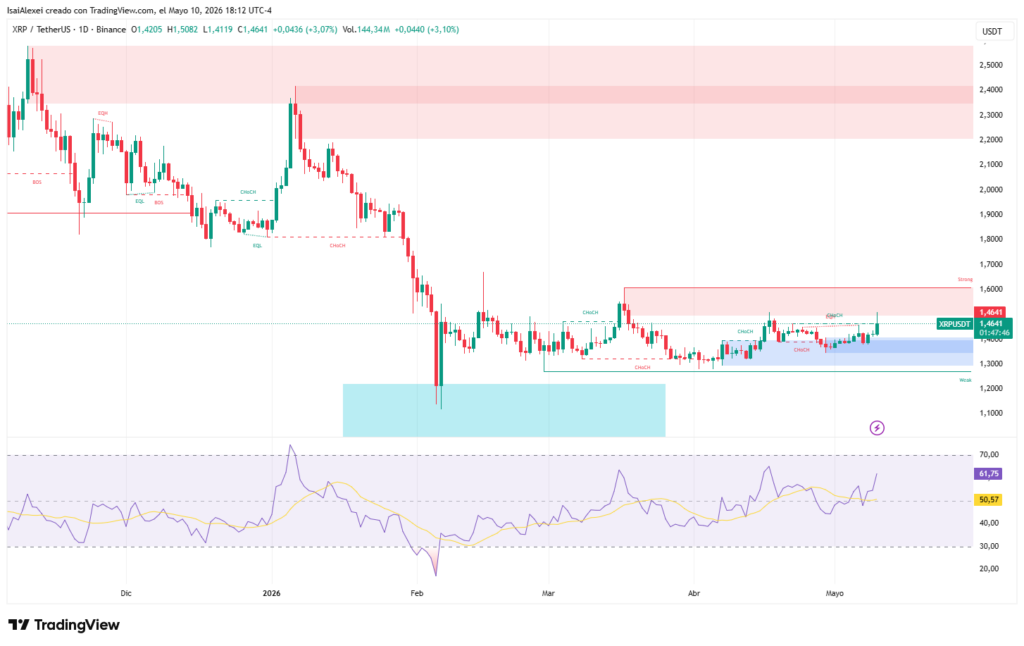
A recovery toward $1.50 does not require booming retail participation. It requires continuation of the silent accumulation pattern already underway, accompanied by a stable floor in on-chain usage that puts a hard bottom under price.
